Table of Contents
The Quiet Truth We Only Notice When the Power Goes Out
It takes just a few hours without electricity for the modern world to reveal its deepest dependency. The lights flick off, the fridge warms, the Wi‑Fi dies, and suddenly the invisible force that holds our lives together becomes painfully obvious. Even camping—our cultural shorthand for “roughing it”—still depends on energy. You pack food, and that food is stored energy. You cook over fire, which is stored energy. You move your body, which runs on the energy you ate.
Strip everything down and you find the same root: energy is the currency of existence. Plants capture sunlight. Animals eat plants. We eat both. The sun itself is a fusion engine made of particles and quantum forces. Everything we touch, build, burn, or become is a transformation of energy.
Energy is not just part of life. Energy is life. And the story of civilization is the story of how we’ve tried—again and again—to bottle it.
From Fire to Fossil Fuels: Humanity’s First Attempts at Bottling Power
Early humans learned to burn wood for warmth and cooking. Then we discovered that tree resin burned longer. Whale oil burned brighter. Eventually we found thick black tar in the ground, and gases that ignited with a spark. Each discovery felt like a miracle—another way to store the sun’s ancient power.
But every solution came with a shadow. Smoke filled homes. So we built chimneys. Smoke filled cities. So we built taller stacks. “The solution is dilution,” we told ourselves, pushing pollution higher into the sky. But the sky pushed back. Smog settled. Health declined. Oceans warmed.
Every time we solved one problem with combustion, another emerged. Fossil fuels gave us incredible power, but they also locked us into a cycle of extraction, pollution, and eventual depletion.
And yet, above us, the original fire still burned—clean, constant, and unimaginably abundant.
The Sun: The Ultimate Power Source We Forgot How to Bottle
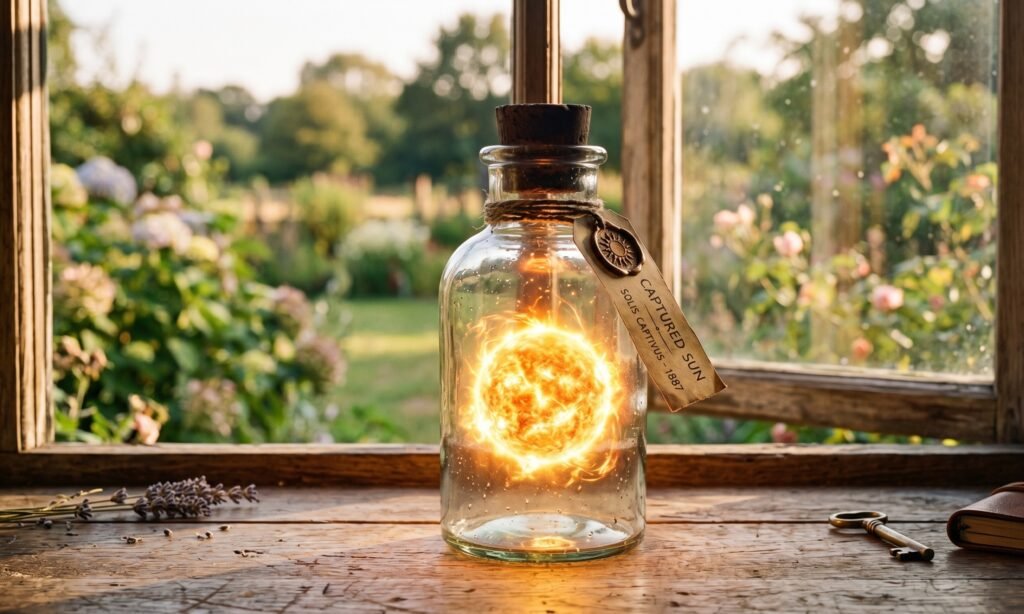
The sun warms us like a fire, but unlike a fire, it doesn’t run out. The challenge has always been the same: how do you bottle sunlight?
Solar panels are one answer. But sunlight is intermittent. Wind is powerful, but unpredictable. Geothermal is steady, but geographically limited. And the truth is simple:
If you can’t store energy, you can’t use it.
A typhoon contains more power than humanity uses in a year, but you can’t bottle a typhoon. You can’t store an earthquake. You can’t save a gust of wind for later.
This is why storage—not generation—is the real frontier. Batteries, thermal storage, hydrogen, gravity systems, and future technologies we haven’t invented yet will determine how far renewable energy can take us.
Because without storage, renewable energy is a fireworks show—beautiful, but fleeting.
With storage, it becomes civilization’s backbone.
Energy Is the Foundation of the Economy
Energy doesn’t just power machines. It powers opportunity. When energy is expensive, people are limited. Their mobility, their comfort, their productivity, their potential—all constrained by cost.
But imagine a world where energy is nearly free. Suddenly every household becomes a micro‑factory of possibility.
With abundant, low‑cost renewable energy:
- Anyone can grow indoor food year‑round.
- Homes can recycle water and process waste on‑site.
- Climate becomes irrelevant—you could live comfortably in Antarctica.
- Entire industries emerge around energy‑rich living: heated sidewalks, indoor parks, climate‑controlled greenhouses, automated food systems, and more.
- Jobs multiply because every new energy‑powered system requires design, manufacturing, installation, and maintenance.
Energy is not just an economic input. Energy is the economy.
When it becomes abundant, everything else expands with it.
Why Fossil Fuels Can’t Take Us to the Future
Even with massive investment, fossil fuels remain a dead‑end road. They will always:
- run out,
- pollute,
- require extraction,
- and create geopolitical tension.
Renewables, on the other hand, scale with sunlight, wind, heat, and motion—resources that don’t deplete. The science is here. The technology is here. The economics are here.
What’s missing is momentum.
Not because the world lacks solutions, but because the world is addicted to oil revenue.
Humanity isn’t short on innovation.
Humanity is short on incentives.
But once the economics shift—and they will—the transition will accelerate faster than any industrial change in history.
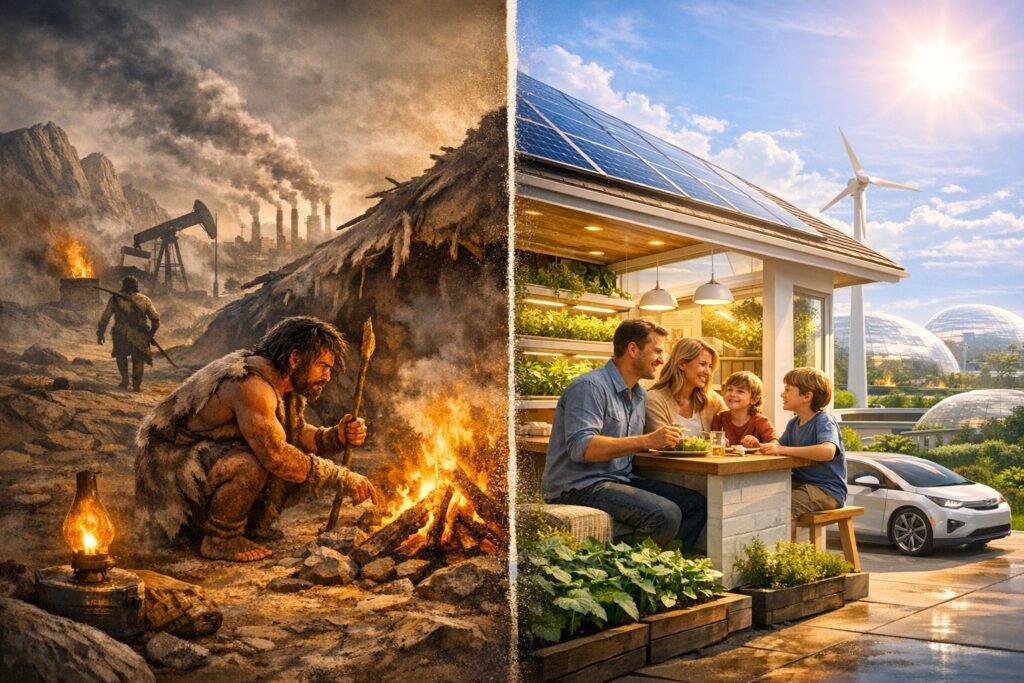
A Vision of Life When Energy Becomes Abundant
Let’s return to the opening scene. The power goes out, and everything stops. Now flip it. Imagine the opposite.
You’re in your home, and the power isn’t off—it’s fully, endlessly ON.
Your region is cold, but your sidewalks and paths are heated. Snow never piles up. Your roof and gutters are temperature‑controlled, reducing wear and extending their lifespan. Your garage stays warm even without insulation.
Instead of mowing grass, you grow food year‑round in a climate‑controlled micro‑farm. Robot helpers tend the crops and deliver fresh produce to your kitchen.
This isn’t luxury.
This isn’t for the wealthy.
This is the consumer market when energy is nearly free.
Cities bloom indoors. Stadium‑sized parks flourish under artificial sunlight. Winter becomes optional. Entire communities thrive in places once considered uninhabitable.
With endless clean energy, we build underwater cities, floating farms, and climate‑proof architecture. We design for creativity instead of scarcity.
Because it takes energy to do anything.
And it takes endless energy to do everything.
Here’s a new section you can add seamlessly after your “Final Thoughts” — it deepens the narrative and ties the physics of energy to the practical reality of electricity, while keeping your visionary tone intact.
Energy = Electricity
At the end of every transformation, energy becomes electricity. It’s the universal language of power—the form we can store, transmit, and control with precision. Whether it begins as sunlight, wind, heat, or motion, nearly all modern energy systems end in electrons flowing through wires.
We burn wood for heat, or fuel for motion, but those are exceptions—ancient echoes of survival. The modern world runs on electricity because it’s adaptable. It can light a city, drive a motor, compute a trillion operations, or power a home garden. Electricity is the bridge between raw energy and human intention.
Globally, more than half of all energy use now converts to electricity in some form—lighting, cooling, computing, manufacturing, and transport. The rest remains locked in direct combustion: heating, industrial processes, and propulsion. These are the hard edges of electrification—the places where gas still rules because of density and immediacy.
A liter of gasoline holds about 9 kilowatt‑hours of energy. To match that with batteries, you need advanced chemistry, cooling, and weight management. That’s why aircraft and rockets still rely on chemical fuels. The physics of thrust demands explosive release, not steady flow. Electricity can’t yet deliver that kind of impulse without converting back into heat or plasma—both inefficient at scale.
Could we ever reach space on electricity alone? Possibly, but not with today’s batteries. Electric propulsion already exists in orbit—ion drives that push satellites with microscopic thrust over months. They’re elegant, efficient, and nearly eternal, but they can’t lift off from Earth. To escape gravity, you need concentrated energy, and that still means combustion.
Yet even here, the frontier is shifting. Plasma engines, solar sails, and electromagnetic launch systems hint at a future where electricity becomes the launch fuel itself. The dream is not impossible—it’s just waiting for the next leap in storage and conversion.
Electricity is the final form of energy because it’s the most obedient. It can be shaped, stored, and shared. It’s the heartbeat of civilization, the invisible thread connecting every innovation. When we master electricity fully—generation, storage, and distribution—we master energy itself.
And when that happens, the world won’t just be powered.
It will be alive with possibility.
Frequently Asked Questions
How is energy connected to everyday life?
Energy powers every biological, mechanical, and digital system we rely on, from heating our homes to fueling our bodies.
Why can’t fossil fuels support long‑term growth?
They are finite, polluting, and increasingly expensive to extract, making them unsustainable for a growing global population.
What makes renewable energy different?
Renewables draw from natural, replenishing sources like sunlight and wind, offering clean power without depletion.
Why is energy storage so important?
Without storage, renewable energy is inconsistent; with storage, it becomes a reliable foundation for modern infrastructure.
How would abundant energy change society?
It would unlock new industries, expand human potential, reduce inequality, and enable climate‑independent living.
Is nearly free energy realistic?
As renewable technology scales and storage improves, the cost of energy continues to fall, making this future increasingly plausible.
Final Thoughts
Energy is the quiet architect of civilization. It shapes our homes, our economies, our opportunities, and our imagination. When we treat energy as scarce, we design a world of limits. When we unlock abundant, renewable power, we design a world of possibility.
The future isn’t defined by what we conserve, but by what we create. And with clean, endless energy, we can create boldly.
Because energy is everything—and when we finally embrace that truth, everything becomes possible.